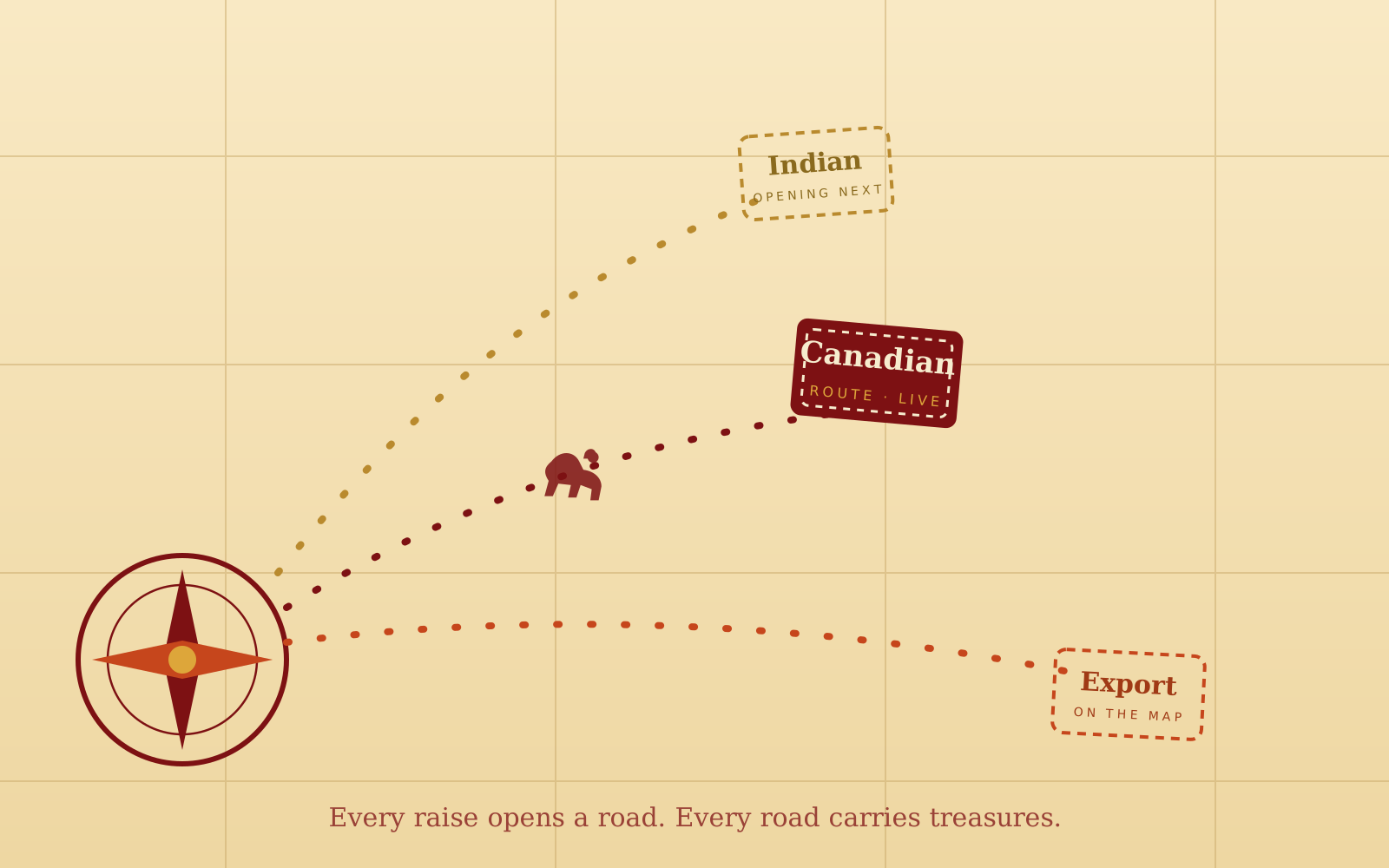
Here is the part of the Silk Route story the romantic versions leave out: every caravan was a financed venture. Before a single camel was loaded, someone had put up capital — for the animals, the drivers, the guards, the goods themselves — against the promise of what the route would return. The history of the great trade routes is not only a history of geography and goods. It is a history of backers.
How the old routes were actually funded
The mechanics were surprisingly modern. Merchants along the route pooled resources for expeditions too large for any one of them — sharing the outlay, sharing the risk of bandits and weather, and sharing the returns when the caravan came home. Across the medieval trading world, from the caravanserais of Central Asia to the ports of the Indian Ocean, variations of the same arrangement appear again and again: one party brings capital, another brings the journey and the skill, and the venture's profits are divided by agreement struck before departure. Silent partners funded voyages they never sailed. Caravan masters carried goods they could never have bought outright. The route ran on trust, but the trust was written down.
And there was a sequence to how the network grew. Nobody funded a thousand miles of unproven road at once. A route was opened stage by stage: a caravan proved the road paid, the returns funded the next season's larger caravan, and the profits of a proven route underwrote the risk of opening a new one. The map you see in history books — that web of roads from China to the Mediterranean — was not planned. It was compounded, one funded journey at a time, over centuries.
The same logic, this century
When we say Silk Route grows the way the old routes grew, we mean it as an operating model, not a metaphor. Each Silk Route route is a defined venture: a geography, a slate of launches it will carry, a capital requirement, and backers who fund exactly that road and share in what it builds. We do not raise a vague pool for a vague future. We open routes.
The Canadian Route is the first, and it is live now. Its cargo is already visible on this website: Pure Desi Ghee from Oxford County launching this Diwali, with edible oils and frozen produce planned behind it — made-in-Canada treasures, launched season by season, sold digitally-first. The route has a goal, a closing date, and a ledger that moves as backers step forward, exactly the way a caravan's manifest filled before departure. Behind it on the map wait the Indian Route — the sourcing engine on the other end of the road — and the Export Route, where the caravan goes after North America.
Why route-by-route is the honest structure
We chose this structure for the same three reasons the old merchants did. First, clarity: a backer of the Canadian Route knows precisely what their capital opens — these launches, this geography, this season. Nothing dissolves into a general fund. Second, proof before expansion: each route must show its road pays before the next one opens, which imposes a discipline no pitch deck can. The ghee jar shipping this Diwali is the Canadian Route's proof-of-road — a real product, on a real shelf, in its first season. Third, aligned company: caravan funding was always relationship capital. The merchants who backed a road travelled it in spirit, vouched for it, opened doors along it. We want backers like that — people who bring a network and a nose for the category, not only a cheque.
What opening a route looks like
In practice, the journey from interest to opened route runs the way our fund pages describe. It begins with the Caravan Letters — telling us who you are and which route calls you, which commits you to nothing and keeps you informed as the ledger moves. Eligible investors are then invited into a private room with the terms, the numbers and the documents. And any actual investment happens the proper, boring, lawyer-reviewed way: through definitive documents, offline, in permitted jurisdictions. The website tells the story and keeps the ledger; it never takes a dollar. The old traders would recognize the sequence instantly — conversation at the caravanserai, terms by lamplight, and only then the loading of the camels.
The ledger itself speaks the caravan's language. Interest moves through three stages, and we name them plainly: Blocked, when an investor has expressed serious interest and asked us to hold a place on the manifest; Committed, when terms are agreed on paper; and Funding the Caravan, when the capital is at work opening the route. Watching the bar move across those stages is watching a caravan being loaded in real time — which is exactly the feeling a route's backers deserve to have.
The invitation
Fifteen centuries ago, backing a caravan was how a merchant family joined a road bigger than itself — how a name from one city ended up trusted in twenty. That is the seat we are offering, updated for this century: a funded route, a named cargo, a ledger you can watch, and a company of fellow travellers building a North American pantry brand with its sourcing conscience intact.
The Canadian Route is open. The map is waiting to be compounded. If the road calls you, walk over to the fund pages and read how it works — and if it does not, stay for the stories and the ghee. Either way, you are part of how routes have always been opened: someone hears about the road, and tells someone else.
This story is informational and is not an offer to sell, or a solicitation of an offer to buy, securities. Any investment opportunity is available only to eligible investors, in permitted jurisdictions, through definitive documents — see the fund pages for the full picture.