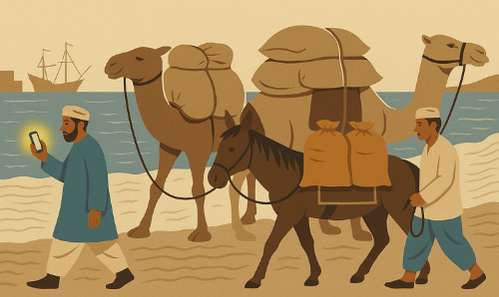
Between the spice coasts and the northern plains rises the Deccan — the vast, ancient volcanic plateau that anchors peninsular India. It is old land in every sense: some of the oldest rock on the subcontinent, farmed and fought over for millennia, crossed by inland trade roads that stitched the pepper ports of the west coast to the markets and courts of the interior.
Its kitchens built their magic on a different register from the north. Not the tandoor's blast of heat, but a slow, layered warmth — sour and bright and deep at once, vegetarian to a degree that astonished early visitors, and organised around two daily miracles: the tempering and the souring.
Five seconds of hot oil
The tempering — tadka, thalippu, oggarane, every southern language has its own word — is the plateau's signature move. Mustard seeds go into hot oil or ghee and crackle. Urad dal turns gold. Dried red chilies darken. And then the curry leaves hit the pan and the entire kitchen changes: that bright, green, unmistakable snap that tells everyone in the house that lunch has begun.
The curry leaf deserves its fame. Fresh from the tree — and southern courtyards keep the tree the way other gardens keep roses — it delivers a fragrance nothing else approximates. It goes in whole, at the beginning and often again at the end, and a southern cook will use a sprig where a cautious recipe says four leaves.
The souring arts
The plateau's second signature is sourness, and its master is tamarind. The brown pods — imli in the north, the soul of sambar and rasam in the south — are pressed into blocks and pastes whose sweet-sour depth gives southern gravies their spine. Rasam without tamarind is soup; with it, it is medicine for the mood, the rainy evening in a bowl. Alongside it work the region's other souring agents — kokum on the coasts, curd everywhere, unripe mango in season — a whole grammar of brightness that keeps the deep spicing from ever turning heavy.
Add the plateau's dals, its coconut from the coastal fringe, its dried chilies and asafoetida and fenugreek, and you have the southern pantry: not a row of luxuries but a working toolkit, tuned over centuries for daily use.
Markets that dazzled travellers
The Deccan was never a backwater between the famous coasts — it was a power in its own right. At its height, the empire of Vijayanagara ruled from a capital that visiting merchants described with open disbelief. The Portuguese traveller Domingo Paes, visiting in the early sixteenth century, wrote of markets overflowing with produce, gems and spice, and called it one of the best-provided cities in the world. The plateau's roads moved pepper and textiles inland, diamonds and grain outward, and fed one of history's great urban spectacles.
That is the Deccan's trade inheritance: substance over show, abundance managed with skill, the inland roads doing quiet, essential work while the coasts took the fame.
The breakfasts that conquered the world
No survey of the south's table is honest without its breakfasts, now beloved on every continent: the dosa's lacy golden crackle, idlis steaming in their trays, vada with its impossible crisp-soft contradiction, upma and pongal for the mornings that need comfort. Each one leans on the plateau's toolkit — the tempering poured over sambar, the curry leaves in the chutney, the asafoetida blooming in hot oil — which is why a southern breakfast anywhere in the world still tastes like the plateau.
It is worth pausing on what that represents: a regional breakfast culture so complete, so balanced and so craveable that it export itself without an empire's help. The Deccan never needed conquest. It had tiffin.
A cook's guide to tamarind
Tamarind intimidates newcomers and shouldn't. The block form — pressed pulp, seeds and all — is the traditionalist's choice: tear off a lime-sized piece, soak it in warm water for ten minutes, squeeze with your fingers and strain. What you get is a fresh, bright extract that bottled concentrates only imitate. Add it late in cooking; long boiling dulls its edge. Balance it the southern way — sourness against heat, a pinch of jaggery if the pot argues back.
Master that one move and half the southern repertoire opens up: sambar with a spine, rasam that clears the head, chutneys with a bright finish. The plateau's warmth, as ever, arrives in layers — and tamarind is the layer that makes the others sing.
There is also a rhythm to the southern kitchen worth importing whole: the week runs on batch wisdom. Sambar powder ground in quantity and stored; tamarind extracted for days ahead; batters fermenting overnight on the counter, alive and patient. It is a cuisine that prepares calmly and finishes quickly — the opposite of panic cooking — and it turns weeknights into assembly rather than labour. Stock the toolkit once, and the plateau does half your cooking before you reach the stove.
Finish, as the south always does, with the rasam test. Tamarind, tomato, black pepper, cumin, curry leaves, a proper tempering — fifteen minutes, one pot. If the result clears your head, brightens the rice and disappears faster than you planned, your pantry has passed. It is the plateau in a tumbler: warm, sour, layered and quietly certain that it has been doing this longer than anyone.
The route today
Our Southern route carries the plateau's toolkit: the curry leaves and tamarind, the mustard seeds and souring spices, the deep foundations of sambar, rasam and a thousand weekday lunches. Single-origin, untouched, packed with their homeland on the label.
Cook a proper sambar with them on a slow Sunday — tamarind squeezed by hand, tempering poured over at the end, curry leaves crackling — and you will understand why this cuisine never needed to shout. The south's warmth arrives slowly, layer by layer. It also stays longest.