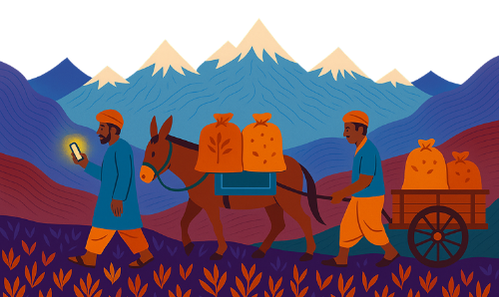
The Himalaya decided where every route would run. The greatest mountain wall on earth stands between the subcontinent and Central Asia, and for the caravan trade it allowed passage only through a handful of high passes — thin, cold corridors where the route squeezed to a single file of men and animals. Crossing them was the most dangerous work the trade knew: altitude, weather, avalanche and sheer exhaustion audited every expedition.
That danger wrote the economics of the high road. A trader does not haul firewood over a five-thousand-metre pass. What came over the mountains had to justify every frozen mile — which is why the Himalayan cargo was always the trade's lightest, rarest and most precious. The high routes were reserved for treasures.
The crimson harvest
Chief among them: saffron. In the mountain valleys of Kashmir, autumn turns certain fields purple with Crocus sativus, and for a few short weeks the harvest runs on a rhythm unchanged for centuries. The flowers open at dawn and must be picked the same day, by hand. From each bloom, three crimson stigmas — the actual spice — are drawn out with fingertips and dried. It takes well over a hundred thousand flowers to yield a single kilogram.
That arithmetic is why saffron has always been the world's most expensive spice, and why it was the perfect mountain cargo: a caravan's entire fortune could ride in a saddlebag. A pinch of true Kashmiri saffron — deep red, potent, aromatic — still transforms a biryani, a kheer or a glass of warm milk the way almost nothing else in the pantry can.
Salt from a vanished sea
The mountains' other great treasure is far older than any trade route. At the western edge of the Himalayan system, the famous salt ranges hold seams of rock salt laid down by a sea that vanished hundreds of millions of years ago — compressed, folded and lifted by the same collision of continents that raised the mountains themselves. Miners have worked these deposits since antiquity; legend has it that troops of Alexander the Great noticed their horses licking the rocks here.
From these seams come the salts the subcontinent has cooked with for centuries: the rose-pink rock salt the world now knows as Himalayan pink salt, and the natural rock salt — sendha namak — traditionally prized for fasting-day cooking. Hauled by caravan across the plains, salt from these ranges was quite literally worth its weight in many markets. The old phrase “worth his salt” was no metaphor on the high road.
The economy of worth
There is a lesson in the Himalayan route that shaped how we built Silk Route. The mountains enforced, brutally, the trader's first question: is this worth carrying? Every object that crossed the passes had passed that test. Nothing diluted, nothing padded, nothing carried out of habit — the altitude priced all of that out immediately.
Every route we run applies that question, but the Himalayan route is where it was written in stone and snow. It is the purest expression of the principle on our packs: only treasures make the trip.
How to judge saffron like a trader
Saffron rewards a buyer who looks closely, which is why the mountain traders inspected it like gem dealers. True saffron is whole threads — trumpet-shaped stigmas, deep crimson with slightly flared orange tips — never powder, which hides everything. The aroma should be unmistakable: honeyed, haylike, faintly metallic. The proof is the bloom: steep a few threads in warm milk or water and real saffron releases its golden colour slowly, over minutes, while the threads keep their shape. Instant, violent colour is the classic sign of dye.
Use it with a jeweller's hand. A pinch — ten to fifteen threads — bloomed first, transforms a pot of biryani, a kheer or a festival milk. More is not luxury; it is medicine-cabinet bitterness. The mountain rule applies in the kitchen too: precious cargo, small doses, full attention.
Salt, ritual and the fasting kitchen
The rock salts of the high ranges carry a cultural weight ordinary salt never earned. Sendha namak — natural rock salt — is the traditional salt of the subcontinent's fasting days, prized as pure precisely because it comes from ancient rock rather than processed brine. During Navratri and other vrat periods, millions of kitchens switch to it entirely. Pink salt, its rosier cousin, brings a gentle mineral character that finishing a dish — or rimming a glass of chaas — shows off best.
Both are, geologically, gifts from a vanished sea delivered by mountain-building — which remains, we would argue, the best backstory of any ingredient in your kitchen.
The high road rewarded one more virtue: patience. Caravans waited weeks for a pass to clear, and no fortune was worth a storm. That temperament suits this route's treasures perfectly — saffron that asks ten quiet minutes in warm milk before it gives you everything, salt that took a quarter of a billion years to arrive at all. Some ingredients are fast. The mountain's are worth waiting for, and always have been.
Keep both treasures the mountain way as well: saffron airtight and dark, where light cannot bleach its oils, and rock salt dry, where it will happily outlast the jar you keep it in. Cargo that crossed the roof of the world deserves shelf space that respects the journey — although, to be fair, the salt has already waited two hundred and fifty million years and is unlikely to complain.
The route today
Our Himalayan route carries the high road's inheritance: the pink and natural rock salts of the ancient ranges, and saffron worthy of the valleys it comes from — single-origin, honestly graded, untouched.
Use them the way the mountains taught: deliberately. A few threads of saffron, bloomed in warm milk, where they can be seen and tasted. A grind of pink salt at the finish, where its mineral character matters. These are not everyday commodities to pour with a heavy hand — they are the cargo that once justified the hardest miles on the map, and they still behave like it.