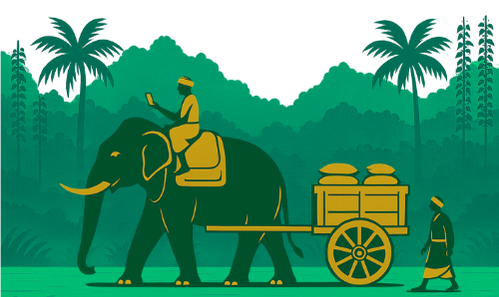
Long before anyone drew the Silk Route on a map, ships were leaving the Malabar coast of southwestern India loaded with a single dark treasure: black pepper. The green vine that produces it, Piper nigrum, is native to these wet hills — and for most of recorded history, this one coastline was effectively the world's pepper supply.
Getting there was the hard part. The breakthrough came when sailors of the ancient world learned to ride the monsoon winds — the seasonal system that could carry a ship straight across the Arabian Sea from the Red Sea ports to the Indian coast in weeks rather than months of coast-hugging. Once that route opened, Roman trade with the Malabar ports exploded. Ancient accounts describe fleets making the crossing every season, returning loaded with pepper, and the port of Muziris in Kerala became one of the ancient world's great emporiums.
The spice that emptied Rome's coffers
Rome could not get enough. Pepper appears throughout the empire's greatest cookery collection; it seasoned everything from meat to sweets. Pliny the Elder famously grumbled that India was draining the empire of its gold to pay for luxuries — and pepper was the chief culprit. The complaint did nothing to slow demand.
The most dramatic testimony came in 408 AD, when Alaric and his Goths laid siege to Rome. Among the ransom demands recorded for lifting the siege: three thousand pounds of pepper. A besieging army, in a position to demand anything, asked for spice. That is what the Malabar coast meant to the ancient world.
Through the medieval centuries the pattern held. In Europe, peppercorns were counted out singly, used to pay rents, taxes and dowries — the phrase “peppercorn rent” survives in English law to this day. Venice grew rich as the middleman of the pepper trade. And when Portuguese navigators finally rounded Africa in 1498, the destination Vasco da Gama sailed for was precisely this coast — Calicut, in Kerala. The age of European exploration was, to a startling degree, a search for a shorter route to Malabar's pepper.
What the coast grows
Pepper was never the coast's only treasure. In the same wet hill country grows cardamom — the fragrant green pods that perfume chai, biryani and desserts across the subcontinent, so prized that the hills of Kerala's high ranges are literally called the Cardamom Hills. Ginger and turmeric thrive in the same climate. The great Malabar ports were where all of it met the sea.
Those harbours were where East and West actually met, centuries before the phrase became a cliché. Arab dhows, Chinese junks and, later, European carracks anchored in the same roadsteads, trading through the same merchant houses. The coast absorbed all of it and stayed, stubbornly and gloriously, itself.
Why Malabar pepper still matters
Terroir is not a word invented for wine — it applies with full force to pepper. The Malabar coast's combination of monsoon rainfall, laterite soils and wet-hill climate produces peppercorns with a depth that generic “black pepper” — often blended from many origins into anonymity — simply does not match. A good Malabar peppercorn is aromatic before it is hot: floral, woody, almost citrusy under the familiar bite.
That is the difference single-origin makes, and it is easy to taste. Grind fresh Malabar pepper over anything — eggs, dal, roasted vegetables, even strawberries — and compare it to the grey dust of a diner shaker. One is a spice with a homeland. The other is a seasoning with a supply chain.
The wars pepper started
The Portuguese did not keep the sea route to themselves for long. The Dutch and English East India companies — arguably the world's first multinational corporations — were founded in large part to contest the spice trade, and Malabar pepper sat near the centre of their ambitions for two centuries. Forts were built along the Kerala coast, treaties were signed and broken with local rulers, and the price of pepper in Amsterdam and London moved fleets. It is genuinely difficult to name another food that has redrawn as many maps.
The coast itself absorbed every wave. Trading communities from across the world settled in its port towns centuries ago and remain part of Kerala's fabric today — living proof of how long this shore has been talking to the world.
Using pepper the way the coast does
A few habits from the source, worth stealing. Buy whole peppercorns, always — pepper's aroma lives in volatile oils that begin fading the moment the corn is cracked, which is why pre-ground pepper tastes of dust rather than fruit. Grind at the table, coarsely, where the aroma has nowhere to hide. Bloom cracked pepper briefly in hot ghee or oil at the start of a dish and it turns rounder and deeper; add a fresh grind at the end and it turns bright and sharp. Same corn, two different instruments.
And do not confine it to savoury food. On the coast, pepper meets pineapple, banana fritters and even strong coffee without anyone raising an eyebrow. Two thousand years of practice earns that kind of confidence.
Kerala's own kitchens, incidentally, treat their famous export with easy familiarity. Whole peppercorns go into the coast's meat stews and into the fiery pepper-forward dishes the region cooks when the monsoon makes everything damp; crushed pepper meets coconut and curry leaves in combinations the rest of the world is still discovering. The people who grew the world's most contested spice for two millennia never turned it into a trophy — it is simply, gloriously, dinner. That may be the coast's best lesson of all.
The route today
Our Coastal route honours that shore. The black pepper on our shelf comes from the coast that taught the world what pepper is, and it travels to you the way every Silk Route treasure does: single-origin, untouched, with its homeland printed proudly on the pack.
When you crack it over your food tonight, you are finishing a journey that Roman senators funded, Arab navigators mapped and Portuguese captains fought over — completed, these days, with considerably less bloodshed and a much better delivery experience. The route is ancient. The treasure has not changed at all.