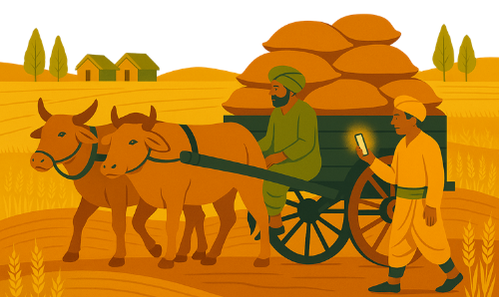
Punjab announces its geography in its name: panj aab, five waters — the five rivers that comb down from the Himalaya and braid across the northern plains. Where they flow, they leave some of the most generous farmland on earth. Where the land is generous, the food is generous. And Punjab's table has never once been accused of holding back.
This is the subcontinent's bread basket — the plain of wheat fields running to the horizon, of mustard flowering yellow in winter, of dairy so central to daily life that a tall glass of lassi is practically a birthright and butter is a food group. It is also, historically, a land of farmers and soldiers: people who spent their days in physical work and expected dinner to notice.
Cooking with its sleeves rolled up
Punjabi cooking is built for exactly that audience. The tandoor — the barrel-shaped clay oven glowing at the heart of village and dhaba alike — turns out naans and rotis blistered in seconds at ferocious heat, and gave the world tandoori cooking. Winter brings sarson da saag, mustard greens slow-cooked to silk, paired by law of custom with makki di roti and a spoonful of white butter. Dals here are not polite side dishes; they are slow-simmered, generously finished mains.
The spicing matches the temperament. Cumin toasted dark until it smokes with warmth. Coriander used by the confident handful. Carom seed — ajwain — sharp and thyme-like, cutting cleanly through the richest gravies and kneaded into the flakiest parathas. Black pepper, fenugreek, dried fenugreek leaves crumbled over a finished dish like a signature. These are not shy spices, and they were never meant to be.
The gateway of the routes
Punjab's other inheritance is the road itself. The great overland routes into the subcontinent came through the northwest passes and ran straight across these plains — the corridor that the Grand Trunk Road, rebuilt and extended in the sixteenth century by Sher Shah Suri, turned into one of Asia's greatest arteries. For centuries, traders, armies, pilgrims and ideas moved along it, and Punjab was the land they crossed first.
Every caravan left something behind. Central Asian dried fruits and nuts settled into Punjabi sweets and pilafs. Techniques and tastes moved both ways. The samosa itself — now the subcontinent's beloved street snack — traces its ancestry to Central Asian travellers' fare that came down these very roads and was adopted, improved and made irreversibly local. Punjab has always known what the best crossroads know: take what arrives, feed it well, and make it family.
Harvest as festival
It is no accident that Punjab's biggest celebrations are agricultural. Baisakhi, in April, marks the wheat harvest with fairs, bhangra and tables that groan. Lohri, in January, circles the winter bonfire with peanuts, popcorn and jaggery. The calendar itself is organised around the land delivering — and the kitchen saying thank you at full volume.
That is the spirit our Northern route bottles: abundance treated with respect, flavour built for appetite, nothing dainty and nothing wasted.
The dhaba: Punjab's gift to the highway
You cannot tell the story of Punjabi food without the dhaba — the roadside eatery born on the truck routes that inherited the old caravan roads. Drivers hauling freight across the north needed what travellers on these plains have always needed: hot, honest, abundant food at any hour. The dhabas delivered — dal makhani simmering since morning, rotis coming off the tawa in relays, charpais to sit on and no ceremony whatsoever.
In time, the dhaba became an institution the whole subcontinent loves, and 'dhaba-style' became shorthand for a certain kind of cooking: generous, smoky, unfussy, seasoned with confidence. It is the direct descendant of feeding travellers on the Grand Trunk Road — hospitality as infrastructure, which is a very Punjabi idea.
The dairy heartland
Punjab's other pillar is dairy, and it shapes everything. This is a land measured in milk: paneer folded into saag and gravies, white butter melting over hot makki di roti, lassi churned tall and cold in brass tumblers, and ghee — always ghee — finishing dals, frying parathas and marking celebration. A Punjabi kitchen without dairy is a contradiction in terms.
That heritage is one reason our Diwali ghee launch feels at home on this route's shelf. The land of five rivers has always known what our newest route proves: great dairy country and great food culture are the same discovery, made twice.
The plains gave the routes one more thing: resilience. Punjab's history is a long ledger of armies passing through, borders moving and hard seasons endured — and its answer, every time, has been to plant again, cook big and keep the langar tradition alive: the community kitchen where anyone, of any faith or standing, eats free, seated as equals. Feeding people well, at scale, without ceremony or condition, is the region's deepest reflex. Any brand that carries Punjab's spices carries a little of that obligation too: the food must be honest, and there must be enough.
Even the drink of these plains tells the route story. Chai came to Punjab down the same roads as everything else and was promptly made local: boiled hard with milk from the family buffalo, sweetened without apology, spiced with cardamom and ginger against the winter fog. A steel tumbler of it at a dhaba counter, alongside a paratha shining with ghee, remains the definitive breakfast of the northern road — cheap, hot, generous and completely sure of itself, exactly like the land that serves it.
The route today
Our Northern route carries the hearty backbone of the spice shelf — the cumin, coriander, ajwain and warming spices that Punjabi cooking runs on, each one single-origin and untouched, the way a Punjabi grandmother would demand. (She would check. You know she would check.)
Cook with them properly: toast the cumin darker than feels safe, be generous with the coriander, finish the dal with something rich, and serve more than anyone could possibly eat. That is not a recipe. In the land of five rivers, it is a philosophy.