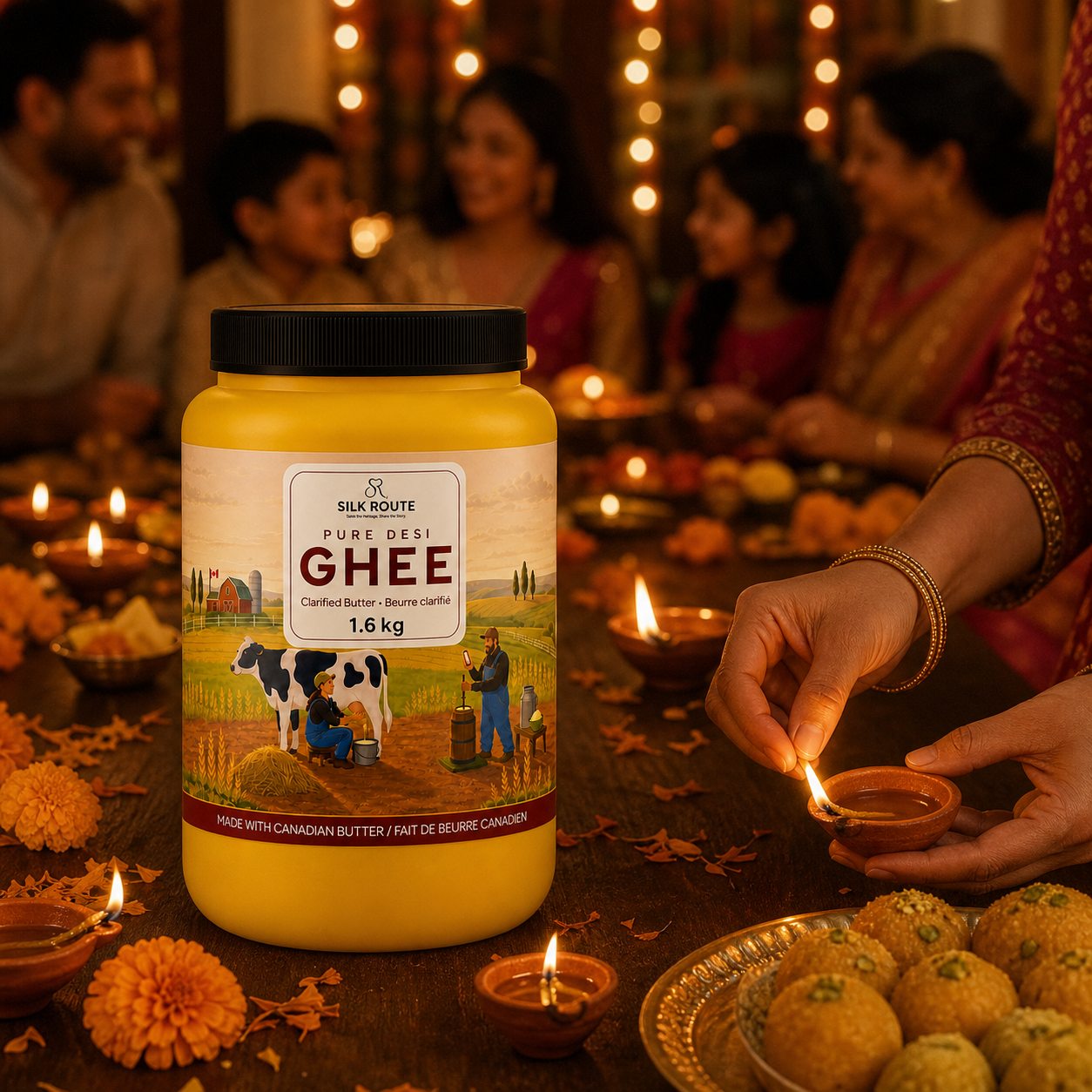
Before the fireworks, before the gifts, before even the sweets — Diwali begins with a wick resting in a small clay lamp. And traditionally, the lamp is filled with ghee. The diya is the festival's first act and its oldest one: rows of small flames along windowsills, doorsteps and balcony rails, each one an invitation to light, to prosperity, to family finding its way home through the dark half of the year.
There is a reason ghee earned that place of honour. A ghee flame burns clean and steady, with a warm golden light that oil lamps struggle to match. In homes across the subcontinent — and now across Canada — lighting the first ghee diya of Diwali is the moment the festival truly starts. Everything else follows that flame.
The kitchen takes over
Once the lamps are lit, Diwali moves to the kitchen, and the kitchen runs on ghee more completely than at any other time of year. The mithai that define the season are built on it. Besan ladoos, rolled warm by hand, get their nutty depth from besan roasted patiently in ghee. Halwa — carrot, semolina, moong dal — begins with ghee shimmering in a heavy pan. Barfi gets its shine from it. Even store-bought sweets are judged, quietly and mercilessly, by whether they taste of real ghee or a shortcut.
Then comes the feast itself, and the feast begins with a sound: the tadka. Cumin seeds, mustard seeds, curry leaves or dried chilies meeting hot ghee, crackling and blooming, releasing in five seconds everything those spices carried from their homelands. A tadka made in ghee is richer, rounder and more fragrant than one made in oil — every home cook knows it, even the ones who save ghee for special occasions.
Diwali is the week when nobody saves the ghee. The parathas get brushed generously. The dal gets a spoonful stirred in at the end. The rice gets its glossy finish. For seven days, the most honest ingredient in the pantry works overtime — in the lamps, in the sweets, in the food, on the table where three generations sit down together.
Why we chose Diwali to launch
When we decided that ghee would be Silk Route's first launch beyond spices, the timing chose itself. If ghee is going to carry an entire festival — its light, its sweetness, its feast — then it should be worthy of the job. And worthiness, for us, always comes back to the same promise: nothing added, nothing hidden.
Our jar says it as plainly as a label can. Ingredient: Milk Fat. Nothing else added. That is the entire list. No colours — the deep gold in the jar is the butter's own, developed in the slow simmer, not poured in from a bottle. It is the zero-adulteration promise that built our spice shelf, applied to the one ingredient Diwali cannot happen without.
Closer to home than ever
Here is the part that makes our jar different from most on the shelf: it did not cross an ocean to reach your table. Our Pure Desi Ghee begins in Oxford County, Ontario — the Dairy Capital of Canada — where generations of family farms produce some of the country's finest milk and butter. We slow-simmer that Canadian butter into ghee the traditional way, the way it has always been made, and jar it at 1.6 kilograms: a family size, built for a season of feasts rather than a sample taste.
Most ghee travels for months to reach a Canadian kitchen. Ours travels a couple of hours. For a festival built around freshness, family and light, we think that matters — and we think the old traders, who prized the shortest honest route to the finest source, would agree.
Why the flame burns golden
There is honest kitchen science behind ghee's festival role. Clarifying butter removes its water and milk solids, leaving nearly pure milk fat — which is why ghee keeps beautifully at room temperature, why it can be heated well beyond the point where butter burns, and why a ghee-fed wick holds a steady, bright, clean flame. The same properties that made ghee the subcontinent's great cooking fat made it the lamp fuel of choice for its most important nights.
It is also why ghee behaves so well in the Diwali kitchen. Sweets fried in ghee crisp instead of scorching. A tadka in ghee blooms spices at a heat that would send butter bitter. The ingredient is not traditional by accident; it is traditional because it works, and has worked for thousands of years.
The gift that needs no wrapping
Diwali is also gifting season, and food gifts carry a particular weight: they say I want your house to be full. Boxes of mithai travel between homes all week. Dry fruits arrive in decorated trays. And in many families, especially ones that cook, a fine jar of ghee is a gift of real standing — practical, generous and impossible to fake, because the first tadka tells the recipient everything about its quality.
A 1.6-kilogram jar with a one-line ingredient list and a Canadian origin story makes that gift easily — and the story on the back label does the explaining for you.
A week of ghee, well spent
If a 1.6 kg jar sounds ambitious, Diwali will make short work of it. The first spoonfuls go to the diyas on the night of Lakshmi Puja. The next batch goes into the ladoos and halwa, made a day ahead so the house smells right when guests arrive. Feast day claims the biggest share: the tadka for the dal, the finish on the biryani, the shine on the rotis coming off the tawa. And the leftovers week — everyone's secret favourite — runs on ghee-fried parathas eaten standing in the kitchen.
By the time the last diya is packed away, the jar is lighter and the house has been fed properly. That is what ghee is for.
This Diwali, when you light the lamp and start the tadka, the treasure in your hand will be one ingredient long, made in Canada, and fresher than any jar that spent a season at sea. The festival of lights deserves nothing less — and, honestly, nothing more.