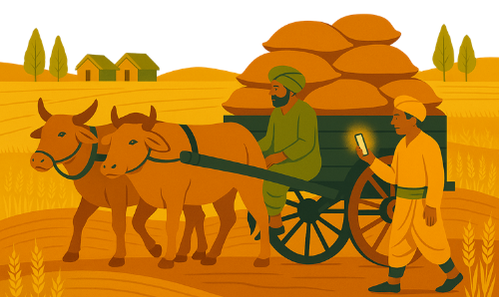
There is a detail about the old caravans that most histories mention only in passing: of everything loaded onto the camels, one category of cargo was both merchandise and survival kit. The dry fruits. Almonds, pistachios, walnuts, raisins, apricots dried to leather in the orchard sun. A sack of pepper could make a trader rich, but he could not live on it across a desert. The dry fruits he could sell at the destination and eat on the way. No other cargo did both jobs. That double life — treasure and ration — is why nuts and dried fruits travelled every arm of the Silk Route, in both directions, for as long as the route existed.
Built for the journey
Think about what a caravan asked of its cargo. Months of travel. Brutal heat by day, cold by night. Jolting over stone passes, damp river crossings, dusty desert stages. Fresh fruit lasted days; grain was heavy and cheap at both ends; meat needed constant attention. But a dried apricot is the orchard with the water taken out — light, dense, keeping for a year. An almond in its shell is nature's own sealed pack. Pistachios, walnuts, raisins: every one of them is a food the road cannot easily ruin. The caravan did not carry dry fruits because they were exotic. It carried them because they were engineered by the sun for exactly that journey.
Geography wrote the rest. The orchard belt of the old world — Persia, the Hindu Kush valleys, Samarkand's famous gardens, Kashmir — sat squarely across the middle stretches of the route. Caravans heading east and west both passed through nut country. Loading up was not a choice; it was the road itself handing you cargo.
The currency of celebration
Somewhere along those centuries, the dry fruits picked up a second meaning, and the subcontinent gave it its fullest form. Because they travelled far and kept beautifully, they became the gift you could give with confidence — the box that would not spoil before the wedding, the tray sent to seal an engagement, the first thing offered to a guest you wished to honour. To this day, festivals across South Asian households run on the same logic: Diwali trays layered with almonds and cashews, Eid tables set with dates and pistachios, winter weddings measured in kilograms of dry fruit given and received. When a family in Brampton or Surrey hands over a decorated box of mixed mewa, they are performing — usually without knowing it — a gesture the caravans invented: this travelled far, it kept its worth, and now it is yours.
That is why our Nuts & Seeds vertical carries the tag "on the road." Not as a cute status label, but as the category's oldest truth. These are the treasures whose entire identity is the journey.
The languages of the subcontinent even carry the history in their words. The everyday term for the category — mewa — arrived along the same roads the goods did, and the finest grades were long called khushk mewa, the dry treasure, priced by origin the way jewellers price by mine. A Kandahari raisin, a Kashmiri walnut, a Sindhi date: the place-name was the brand, centuries before anyone printed a label. Ask an elder how they judge a tray of dry fruit and you will still hear geography before you hear price.
What the shelf does to a treasure
Fast-forward to a Canadian grocery aisle and the dry fruit has been thoroughly de-storied. Bulk bins with a number and a price. Bags whose labels tell you a packing city, not an orchard. Mixed pouches blended for cost, roasted and salted into sameness. The nut aisle is the spice aisle's story all over again: a category rich in origin, sold as if origin did not exist. A pistachio from one valley and a pistachio from a bulk consolidator are priced within cents of each other, because the label gives you no way to tell them apart — and so the finer orchard eventually stops bothering. Silence on the label always flows upstream.
We think the dry fruits deserve what the spices are getting from us: named origins, honest handling, and a route you can trace. The caravan classics — almonds, cashews, pistachios, raisins — chosen the way a trader chose, from the places that have grown them longest and best, packed sealed-fresh rather than scooped from a bin.
What "on the road" means at Silk Route
Now the part we want to say plainly, because it is a promise about how this website behaves. Nuts & Seeds is a vertical we have announced but not launched. You will notice its page shows no products, no prices, no "add to cart." That is deliberate, and it is permanent policy: no treasure appears on our shelves before it is real — sourced, packed, proven and physically ready to ship. "On the road" means exactly what it meant for a caravan: the goods are moving, the arrival is certain, and the honest thing to show you in the meantime is the route, not a mock-up.
When the first pouches land, the nuts page becomes their shelf — live, like the spice shelf, with each treasure carrying its origin and its story. Until then, the page will tell you what is coming and let you ask to be told the moment it arrives. That is the whole transaction we want before launch: your curiosity for our honesty.
The road ahead
The old traders had a saying's worth of wisdom in how they loaded a caravan: carry what survives the journey and is worth it at the end. It is as good a filter for a modern pantry brand as it was for a camel train. The dry fruits passed that filter for fifteen centuries. They will pass it again — this time on a road that ends not at a bazaar in Samarkand, but at your door, a tap away.
The caravan is loaded. It is on the road. And when it arrives, you will know exactly where everything on it came from — because that has always been the difference between cargo and treasure.