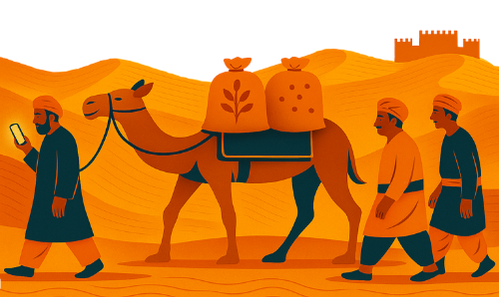
The Thar desert looks, at first glance, like the last place a great food culture should flourish. Rainfall is scarce and cruel in its timing. Summer temperatures are merciless. Fresh produce, for most of history, was a seasonal miracle rather than a daily expectation. And yet the kingdoms of Rajputana — the land of warrior clans and forts rising straight out of the sand — built one of the subcontinent's boldest and most distinctive pantries precisely because of the desert, not despite it.
Scarcity is a ruthless teacher. In a land where little grows and less keeps, flavour had to be durable. The desert kitchens learned to build their cuisine on things that lasted: grains that thrived on almost nothing, dairy from herds that could walk the dunes, and — above all — spices and preserved ingredients intense enough to transform the simplest meal.
Flavour built to last
Consider what the desert table actually looked like. Bajra — pearl millet — ground and slapped into thick rotis. Buttermilk to drink. Dried beans and desert pods, like the famous ker berries and sangri beans, cooked into dishes that need no fresh vegetables at all. Papad and badi, dried and stored. Gatte — chickpea-flour dumplings — simmered in yogurt gravy, because yogurt kept when vegetables didn't.
None of it works without intensity, and intensity was Rajputana's specialty. Chilies dried in the desert sun until their fire and colour concentrated, then stored for months without losing either. The region around Jodhpur became famous across India for exactly this — desert-grown red chilies prized for a colour and heat that milder climates cannot reproduce. Rock salt, carried from ancient deposits, seasoned everything. Whole spices — cumin, coriander, fenugreek — were toasted hard and used with confidence.
The desert as a highway
Here is the paradox that made these kingdoms rich: the same desert that starved the kitchen fed the treasury. The Thar was not a barrier — it was a highway. Camel caravans moved in trains between the great fort cities — Jaisalmer, Bikaner, Jodhpur — linking the ports of the west coast and the markets of Delhi to the routes that ran onward through the mountain passes toward Central Asia.
Jaisalmer's golden sandstone havelis — merchant mansions carved like jewellery boxes — were built on caravan profits. The desert cities levied duties, provisioned the camel trains, and sent their own traders out along the routes. Rajasthan's merchant communities became legendary across the subcontinent and far beyond it, famous for exactly the skill the desert demanded: judging value precisely.
The severity of the caravan master
That skill is the heart of this route's story. In the desert, carrying dead weight could be fatal. Every kilogram loaded onto a camel had to justify its water, its fodder, its share of the journey's risk. So nothing worthless made it onto a camel's back — not once the caravan master had inspected it. Goods were tasted, weighed, squeezed and argued over before they were loaded, because the desert would audit every decision without mercy.
It is, we think, the purest expression of the trader's discipline anywhere on the old routes: if it is not worth carrying across a desert, it is not worth carrying at all.
The desert pantry, decoded
Spend time with Rajasthani cooking and its logic reveals itself dish by dish. Ker sangri — desert berries and beans, sun-dried and cooked with chilies and buttermilk — is the desert making a delicacy out of what the dunes offer. Papad ki sabzi turns a crisp lentil wafer into a curry when there are no vegetables to be had. Gatte ki sabzi builds dumplings from chickpea flour and simmers them in spiced yogurt. Dal baati churma bakes wheat rounds hard in embers, then drowns them in dal and ghee. Every dish is an answer to the same question: how do you eat magnificently in a place that gives you almost nothing perishable?
The answer, every time, is the spice box. Heat from the chilies, warmth from cumin and coriander, brightness from dried mango and pickling spices, depth from salts. The desert kitchen is proof that a great pantry beats a full refrigerator.
What the caravans left behind
The camel trains are mostly gone, but the desert remembers them everywhere. In the havelis of Jaisalmer and the spice bazaars of Jodhpur's old city. In the salt merchants' surnames and the trading families whose descendants run businesses from Mumbai to Toronto. In folk songs that still count the days of a caravan crossing, and in the great camel fairs — Pushkar above all — where the desert's old transport is now its most famous festival.
That memory is why our Western Desert stamp shows a camel. Every pack that carries it is a small descendant of those crossings — the same fire, the same salts, the same severe judgement about what deserves to make the trip.
And if you want the desert's philosophy in a single object, look at the humble papad: a lentil wafer, dried hard in the sun, weightless to carry, keeping for months, and turning into a feast the moment it meets heat. It is caravan logistics as food — maximum flavour per gram, no waste, no fragility. Every pantry that has ever packed for a journey has been trying to reinvent it since.
The route today
Our Western Desert route carries that inheritance. The fierce, sun-dried chilies of the desert kingdoms — extra hot for those who want fire, Kashmiri-style for those who want the deep red glow without the burn. The honest rock salts. The hard-working whole spices of the desert kitchen. Each one chosen with the caravan master's severity, each one carrying its homeland on the pack.
Cook with them the way the desert does: generously, confidently, without apology. A pinch of desert chili in a weeknight dal is a small act of time travel — the same fire that once rode a camel across the Thar, now two taps and a doorbell away.