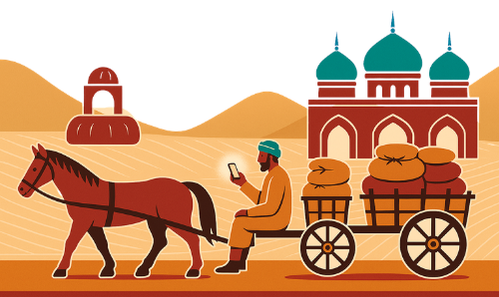
Every trade network has a place where the threads knot together. For the spice routes of the subcontinent, that knot was Delhi. Pepper and cardamom came up from the coasts. Saffron and dried fruit came down from the mountains. Chilies and salt rode in from the western desert. Aromatics arrived from the eastern kingdoms, and beyond them the routes ran on to Kabul, Samarkand and the great markets of Central Asia. Sooner or later, everything passed through Delhi's gates — and Delhi taxed, traded, tasted and transformed all of it.
Geography made this inevitable. Delhi sits where the routes from the Khyber and the northwest funnel down into the Gangetic plain — the doorway between Central Asia and the subcontinent's richest lands. Empire after empire understood this: the city has been founded, sacked and refounded so many times that historians count seven, eight, even more Delhis stacked beside and atop one another. Whoever held Delhi held the crossroads.
The market that never closed
You can still walk into the proof. In Old Delhi, hard by the Fatehpuri Masjid at the western end of Chandni Chowk, the spice market of Khari Baoli has been trading since the seventeenth century — founded in the era when Shah Jahan built his walled capital of Shahjahanabad. It is commonly called the largest spice market in Asia, and after nearly four centuries it has never really closed.
Visit it once and you will never forget it. Sacks of turmeric stacked like sandbags. Towers of dried red chilies. Porters weaving through the crowd with impossible loads on their heads. Air so thick with chili and spice dust that first-time visitors sneeze their way down the lane — locals consider it a rite of passage. Generations of family firms, some trading from the same shopfronts their great-great-grandfathers kept.
What crossroads invent
Something remarkable happens when every spice in the known world passes through one city: people start combining them. The blend — the masala — is the crossroads' great invention, and it could not have been born anywhere else. No single region held all the ingredients. The warming garam masalas of the north, the chai masalas that turned tea into ritual, the tandoori blends that painted the city's kebabs and breads — these are compositions, and Delhi was the concert hall.
The Mughal court accelerated everything. Its kitchens married Persian technique with the subcontinent's pantry, layering aromatics with a refinement that filtered outward from the palace into the city's lanes — where it met street food culture and became something faster, cheekier and utterly Delhi. The city that blends spices blends everything: peoples, languages, recipes, appetites.
The art of the blend
A great masala is harder than it looks. It is not a pile of everything — it is a hierarchy, with top notes and bass notes, spices that announce themselves and spices that only hold the others together. The crossroads traders understood this the way perfumers understand scent. They also understood the tragedy of a bad blend: it is where inferior spices hide. An anonymous masala can bury old, adulterated or exhausted ingredients beneath the loudest ones — which is exactly why our blends are built crossroads-style from spices that each arrive with a homeland of their own, and why the pack tells you what went in.
A walk through the spice lane
If you ever get the chance, walk Khari Baoli at mid-morning, when the day's serious buying happens. The lane works on a wholesale rhythm unchanged for centuries: brokers calling prices, porters — the famous palledars — hauling forty-kilo sacks up staircases older than most countries, shopkeepers pyramiding turmeric and chilies into displays no photograph does justice to. Above the ground-floor chaos, the upper storeys of the old Gadodia Market hold warehouses that have perfumed the same bricks since the British era.
Buyers come from across the country and far beyond: restaurant owners tasting cardamom before committing to a quintal, wedding caterers negotiating saffron, grandmothers who have bought from the same family stall for fifty years and would not dream of defecting. It is loud, it is overwhelming, and it is the closest thing the spice world has to a beating heart.
Building a blend at home
You do not need a palace kitchen to compose crossroads-style. Start with a base the way the old blenders did: coriander and cumin, toasted separately in a dry pan until fragrant — separately, because they finish at different speeds. Add the middle voices: black pepper for lift, cinnamon and clove for warmth. Finish with the top notes — cardamom above all — added last and ground briefly, because their oils are the first to flee. Grind coarse, store airtight, use within weeks.
Or let us do it the Delhi way: our blends are composed from single-origin spices that each arrive with a homeland, listed openly on the pack. Either path honours the crossroads. The only sin is the anonymous jar.
Delhi's table tells the same story from the eater's side. This is the city of chaat — the tangy, crunchy, sweet-hot street snacks that are themselves miniature blends, assembled to order from a counter of chutneys, spices and crisp things. A plate of proper chaat papri is Khari Baoli in edible form: a dozen sources, one composition, balanced by a vendor whose hands have made ten thousand of them. The crossroads does not just blend spices. It blends everything it touches, and it has excellent taste.
The route today
Our Delhi route celebrates the composer's art. The tea spice blend that makes a kitchen smell like a Chandni Chowk morning. The tandoori masala carrying the smoke and swagger of the old city's kebab lanes. The everyday curry blends that put a dozen homelands into one honest spoonful.
One pinch is a map of every route we run — pepper from the coast, chili from the desert, cardamom from the hills — meeting in your pan the way they have met in Delhi for four hundred years. The crossroads, delivered.